
‘Rasta kada goa?’ my guide asks his son in their local tongue. He is surveying the eroded rocky slope. I get nervous. It is never good when the guide asks where has the path gone. The rain has started and we can see the small wooden bridge that we are aiming for at the bottom of the gorge, but not the path down to it. Eventually they find a trail of sheep droppings covering rough, muddy foot-holds. Like Lord Shiva, we follow the sheep track.

Manimahesh Kailash (the peak on the right)
We are attempting to trek to Manimahesh Dal, the lake which sits below the peak of Manimahesh Kailash, the abode of Lord Shiva. We have taken one of the traditional pilgrimage routes that devotees have followed for centuries from the southern Himalayan foothills into the High Himalayas. Some pilgrims still brave these arduous mountain trails, but most now choose the only slightly less treacherous car road to the village of Hadsar, itself a relatively un-demanding 14km walk from Manimahesh.
I have waited years, literally, to trek this route. One spring I waited several months for that winter’s snow to clear, then the monsoon arrived ahead of schedule and I waited again for the return of blue skies. A few days before the arranged October start date, a huge dump of snow arrived and the guide called it off. Storms, locals believe, are Shiva showing his displeasure. “That is Shiva’s land, Eileen. You have no idea when he will get angry,” my friend told me. “And when he does no guide can help you.”
This year Manimahesh has already been shut to pilgrims for several days following a spate of deaths. Rumours are flying around Dharamsala about landslides and blizzards, and of course Shiva’s rage. But it is still only September and Neil, my guide, from the local Gaddi ethnic group, doesn’t seem fazed, so we set off.

The south face of the Dhauladhars and Indrahar Pass
The Gaddis are a semi-nomadic tribe inhabiting the western Indian Himalayas. The Gaddi men, and occasionally women, leave the family home for most of the year, traversing the mountains in search of nutritious grazing grounds for their goats and sheep. They are staunch Shivaites with Manimahesh lying at the centre of their ancestral homeland. Our route is also a traditional Gaddi herding path, and as we approach our first night’s camp, I can see the shelter of blue tarpaulins below patches of forest, and the outline of sheep and goats on the nearby horizon.

My guide, Neil, and a Kisan Chand, a Gaddi shepherd
From here, the crest of the Dhauladhar, the first mountain range to be crossed, appears impassable. Over millennia, rocks have separated from this mountain ridge, creating a river of boulders below. Above this and a few solitary trees, the grey slopes are laced with white threads of snow. I convince myself paths always look different from up close, and it wouldn’t (and couldn’t) be as terrifying as it looked from here. That night’s sleep is disturbed by the incessant barking of the guarding shepherd dogs. Bears come in the night to snatch the sheep, and in my mind, every noise is one.
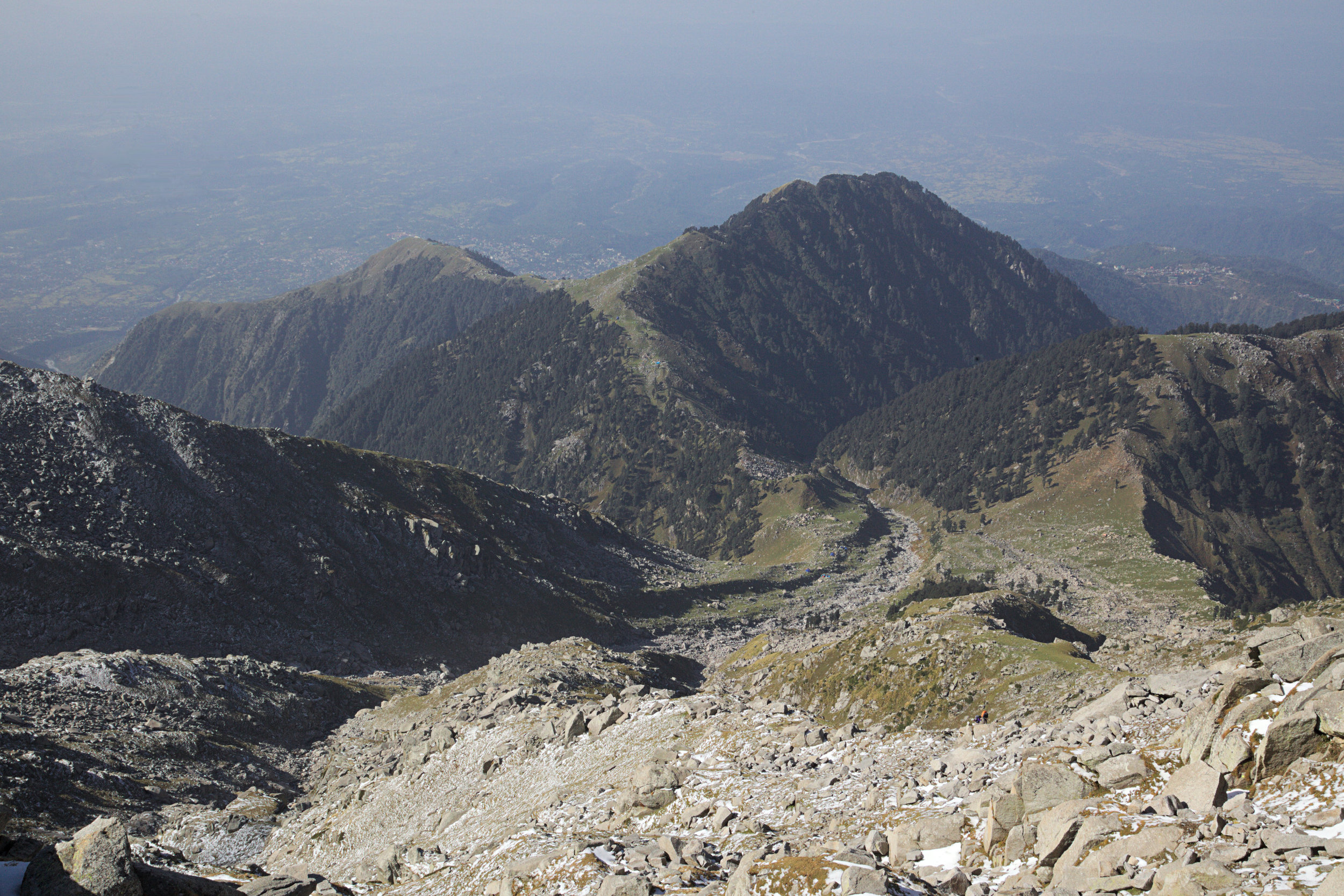
South from Indrahar Pass
At 5am, as the sky in the east began to light up, we set off, tracing our way through the boulders. The gradient increases exponentially and soon regular stops are required to catch breath. We never stop for long, as the icy rocks are too cold for sitting and my toes are numb. We watch the sun-line inch towards us, impatient for its warmth. Pockets of snow are increasing in frequency, soon forcing me to dig my toes into the powder to create a grip strong enough to propel myself upwards.
Our crossing point is Indrahar Pass, a notoriously difficult place to find. The Gaddi shepherds take this route twice a year as they head to and return from the high-altitude plains of Lahaul, and in the extremely steep sections they have sculpted rough, vertical stone steps. Kaka, Neil’s son, regales me with stories of foreigners who have rejected the assertion they needed a guide for this trek, and were never seen again. For the Gaddis, these mountains are home to a web of gods and spirits which demand pacification and respect. Regarding this these foolish foreigners have no comprehension, they tell me, greatly increasing their chances of bad happenings.

My guide’s tracks on the north side of the Dhauladhars

On the way to Kuarsi
After edging round rocky outcrops and hauling myself up these stone staircases, I am relieved to reach the collection of Shiva’s metal forks and red flags signifying Durga Mata’s shrine and Indrahar Pass. We can now see Kailash, standing dominantly over the other peaks of the Pir-Panjal range. “Jai ho,” (hail [Shiva]) Neil says, and then thanks Mata (the Mother Goddess) for our safe passage so far.
On the northern side of the Dhauladhar, the snow is knee-deep and there are no footsteps leading down. Neil gasps as his experienced eyes take in what lies ahead on the distant Pir-Panjals. I try to contain my disappointment as he tells us it will probably be impossible, or at least foolhardy, to attempt the second, higher, pass leading to Manimahesh. But I have been in the Himalayas long enough, and heard a sufficient number of stories, to understand I cannot fight with nature.

A Gaddi flock heading south to Indrahar Pass
After a long, tiring descent in the snow, the sight of autumnal vegetation eventually returns, and we approach that evening’s camp. A huge brown bear saunters down from the forest above to survey the intruders, and I promptly decide to sleep with the guides in their cave, where a huge, flat rock has naturally perched on others to create a small space just big enough to sit underneath.
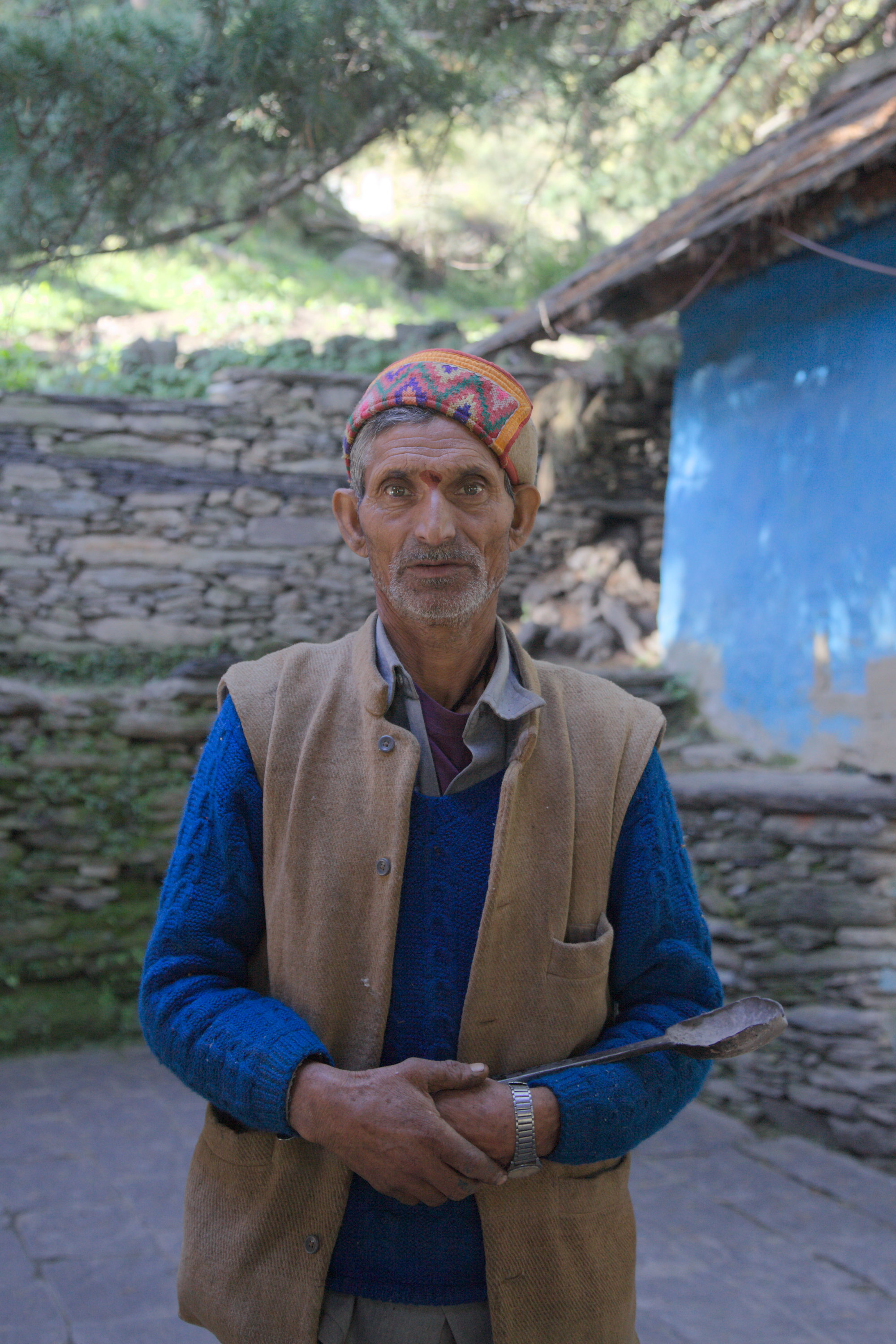
The Brahmin of Kuarsi after the morning aarti
At the camp, Kailash is not in view, but becomes visible again the next day as we tread down the eroded paths of the steep valley to the ancient Himalayan village of Kuarsi. Here our trek will probably end, depending on what the locals advise about Manimahesh. We pass several groups of Gaddis slowly herding their sheep and goats in the direction of Indrahar. “Kitna birf upar?” (how much snow up there?) they ask, although our descriptions appear to provoke no alarm.
I am constantly surprised how the Gaddis navigate Himalaya’s natural dangers with such calmness. Perhaps this is from their unyielding belief in the higher beings of the mountains. Shiva, they maintain, is watching over them, and the network of Mata shrines provide timely opportunities to make the offerings necessary to guarantee their safety in the next stretch.

Morning in Kuarsi
The crumbling paths, often completely destroyed from the heavy monsoon rains, throw up several challenges and the early snow-fall makes it unseasonably cold. It is dusk by the time we reach Kuarsi, and we wearily set up camp on a wooden platform attached in the village’s Nag Temple. No one can tell me from when this temple, whose deity is a cobra, is dated, but they all know the story of its origin.
It is said one Gaddi shepherd accidently dropped a gold earring in the sacred Nag Dal (lake) close to Indrahar Pass. He decided this was an auspicious event and a sign he should also offer his second earring to the Nag god. When he arrived in Kuarsi, he used a local tap to wash his face and was awarded for his generosity as both earrings reappeared in the tap’s water. The same tap is now housed in the temple courtyard next to the idol of the Nag.

A couple of Gaddis leaving Kuarsi
The village Brahmin (Hindu priest) performs an aarti twice a day by circling burning embers in a long metal spoon until they take on the spirit of the Nag. “Hari Om, Hari Om, Hari Om,” he chants the next morning, awakening me from my exhausted sleep. I am still cocooned in my sleeping bag as he comes over to greet us. The snow at Manimahesh, he ascertains, is chest high. “Bahut, bahut Khatarnaak” (very, very dangerous), he says and invites us to stay that night in this home.
As I sip my chai, I make my peace with the trek’s premature ending and watch as Neil fires up the stove for breakfast. A couple of village ladies arrive, smiling shyly. They remove their flip-flops, ring the temple bell and fill their metal pots from the tap. The sun hits Kailash, and Neil breathes another “Jai ho”.
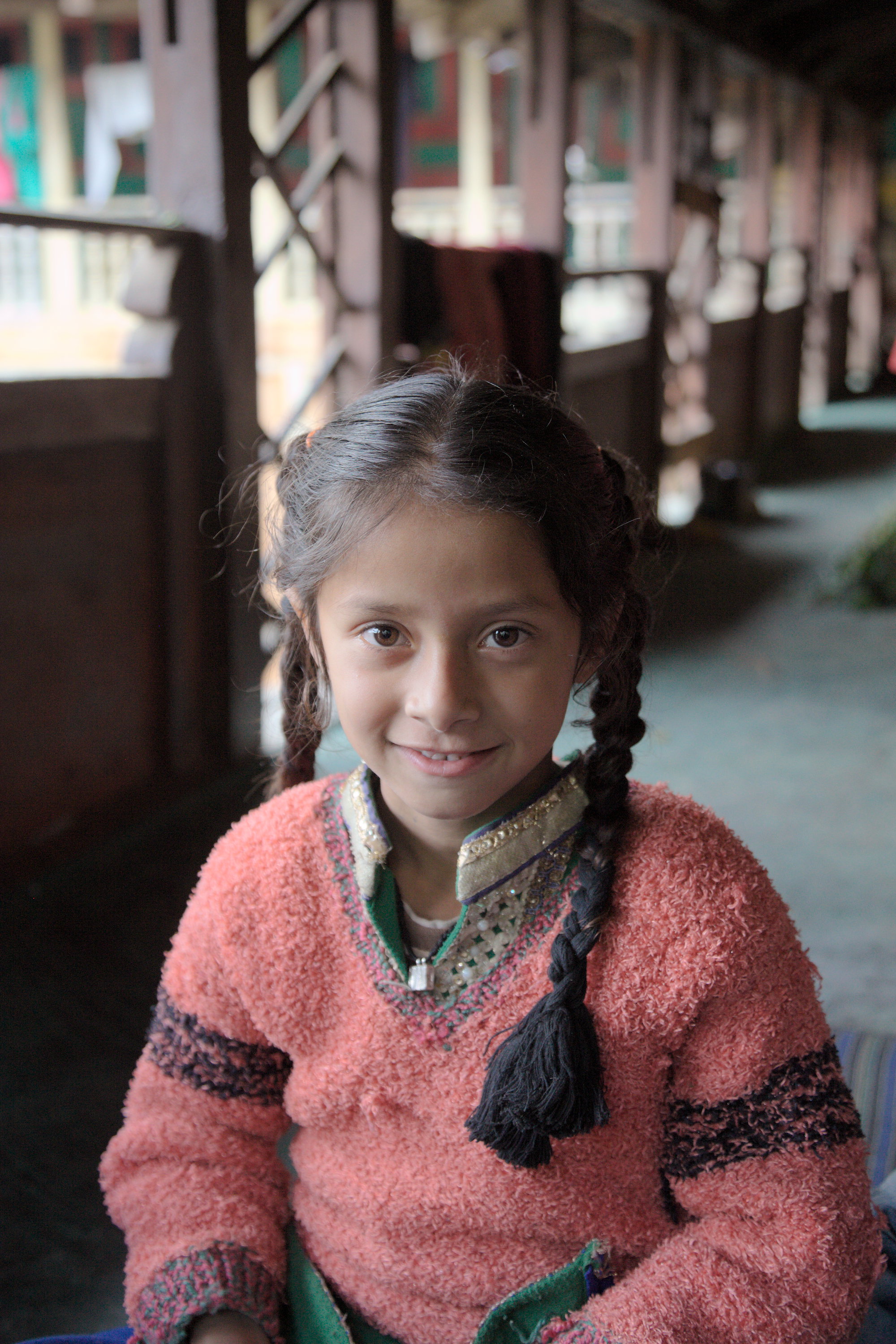
Kuarsi girl

Kuarsi residents