
A crack comes from the direction of the mountain, like a pistol firing. Dust is rising from behind a rocky crag. Then I see it, gathering speed, ploughing over the scree down the mountainside, a trail of debris behind. I watch as the huge boulder continues unforgivingly, crossing our walking path and slapping into the river. It bounces twice and crashes to a stop.
‘Did you see that!?’ I exclaimed to the man who had cooked us daal and rice the night before. My heart was pounding. Tenzin seemed unfazed. ‘It’s God’s Mountain’, he shrugged.

Lakhang Sumdo, the first shelter after crossing the Shingo La into Zanskar

Tenzin, the keeper of Lakhang Sumdo
The day before my friend and I had struggled over the 5000 metre Shingo La (la means pass) from the Lahaul Valley in northern Indian into Buddhist Zanskar, a region accessible by road for only a few months a year. It is four days since we have seen a village, our phone signals dissolved on the journey to Lahaul, and the previous night, we had gladly camped outside a lone stone-walled structure with tarpaulin roof, near the base of Gumbo Rangjan, God’s Mountain.
We had started walking from Darcha, a village around 30 km northeast from the main town in Lahaul, itself only a few dhabas (informal food places) lining the road. For several days we followed the Jankar River upstream, below mountain ridges whose snowy veins feed the grass of the valley below. At our first campground at Palamo, we were lucky enough to be cooked watery daal and rice by an elderly potato farmer from Darcha. In these remote parts, names don’t signify habitations, just geographical structures, such as the confluence of two rivers. By the time we reached the ‘Nepali Hotel’, again without a proper roof, at Zanskar Sumdo on our second night, the choice between noodles and omelette felt like a luxury.

Nepali girl working in the 'Nepali hotel' at Zanskar Sumdo
On the day of the Shingo La, the pass between Lahaul and Zanskar, we rose early, and slowly, constrained by our lungs, followed the silver Jankar River towards its glacial source. The valleys of Lahaul are said to have grass so nutritious it is blue, luring nomadic Gaddi shepherds from the south over treacherous passes for the summer months. Climbing towards the Shingo, we passed a few Gaddis and their flock; the solitary inhabitants of these bare lands. Boulders of all sizes litter the valley, creating waves of grey against the green hillsides, and miraculously pink flowers had sprouted from stony beds.
The mountains to the south shelter Lahaul from the worst of the monsoon, but some clouds had escaped these watchmen and chased us on our ascent up the valley, occasionally obscuring our snow-crowned companions. With the gain in altitude, grey increasingly dominated the green as even the most hardy of vegetation had failed to take root. As we finally approached the pass, the red and pink pinnacles of Zanskar beckoned to us.
We stopped briefly to admire the sky-blue lake and ice cliffs that accompany the Shingo, but deprived of oxygen we hurriedly followed the traffic of ponies and donkeys down to the welcoming valleys. This is where the road ends and from now on all travellers have legs, some better equipped than others to take on the rivers swollen with glacial melt. Not long after the pass, Gumbo, as it is lovingly known, comes into view, marking our way into this fabled land.
Like its better known cousin, Ladakh, Zanskar’s population is predominantly Buddhist and for them, Gumbo Rangjan is highly sacred. It stands alone, mighty and proud, its slopes tapering to a perfect peak. It is the morning after passing the Shingo that we witness the rock crashing from Gumbo’s loins. It dominates our view that entire day, a reminder of our helplessness when faced by the determination of nature.

The way to the Shingo La from Lahual

Zanskari traffic
Still under the eye of Gumbo, we approach Kargyak, the first village in Zanskar. We spend an afternoon and evening here, tired from the pass crossing of the previous day. As we arrive, several men are attempting to erect a banner to welcome an important lama who is expected to arrive on horse from the Shingo the next day. ‘Welcome, have a good day and Tashi Delek (Hello in Tibetan)…’ and some more that I cannot read because it has been wrapped around the right-hand pole. The path, it appears, is not wide enough for the sign.

Pony traffic at the Shingo La
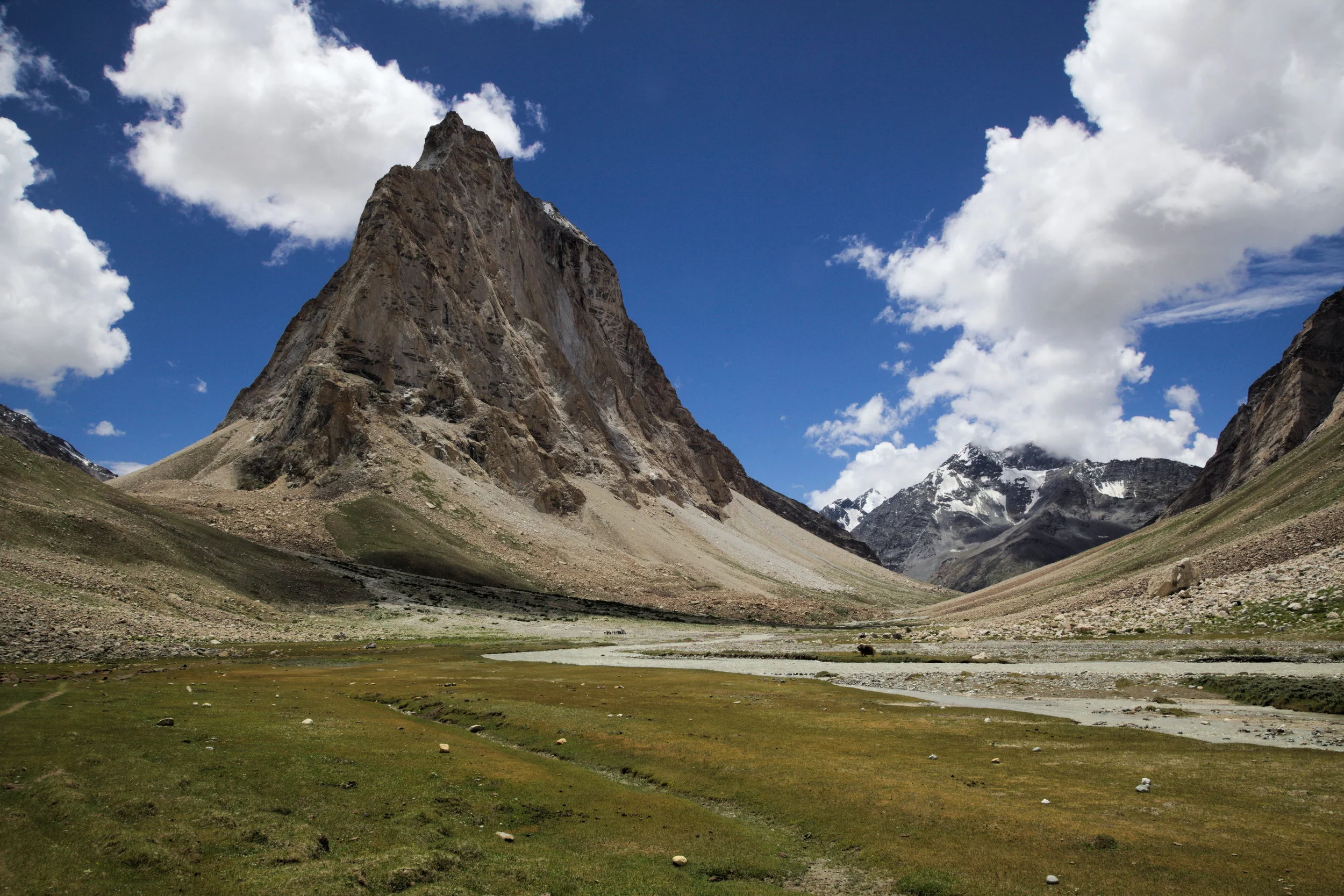
Gumbo Rangjan, the holy mountain
An elderly gentleman, who has been instrumental in the banner erection, agrees to house and feed us that evening. For most of the afternoon, we sit very still at the window, drinking black tea and watching the women of Kargyak continue their crucial preparations for the coming winter. Once the snow arrives, travel to Padum, the only real town, will be extrememly treacherous. The only way out of Zanskar itself is a five day hike along the frozen Zanskar River to Ladakh. “Winter is for sleeping, drinking chang and making babies!” one resident tells me.
To cope with the challenges of living on the edge of the habitable world, the communities of Zanskar have developed sophisticated survival techniques. The majority of food is grown on the scarce pieces of cultivable land which are cleverly irrigated by complex systems, and taken from animals such as yak and dzo (a cross between yak and goat). Yak dung provides fuel for the efficient tandoors, metal ovens with chimneys, which are used for both cooking and heating. Human excrement is deposited into a ‘dry’ toilet: a hole in the floor above a room-like space below, and it is then mixed with soil, decomposed and used as manure. The availability of water depends on the fine balance of adequate snow fall in winters, and the presence of sunlight to melt this snow.

Erection of the welcome banner for the visiting lama

Our hosts in Kargyak, another Tenzin and his aunt

The path between Phuktal and Kyalbok
Climate change is on everyone’s lips as the glaciers recede year on year. One monk shows me how much one glacier had shrunk in his lifetime, and exclaims “Who knows, maybe in 20 years this will all be desert!”. As there is very little vegetation, rain can have devastating effects: occasionally causing landslides to create dams in the gorges. When these break, the pent up water has been known to wash away bridges and even a village. All the elements are needed in moderate quantities for life to be sustained, but with climate change upsetting this balance, conditions can only get more unpredictable.
The main method of transportation in Zanskar is still on horseback and on foot, along narrow paths often cut high into the side of gorges. Shortly after Kargyak, the valley gradually narrows into such a gorge, and we finally lose sight of Gumbo. My heartbeat rises several times as nimbly, we have to navigate sections where scree-fall has submerged the path, trying to forget the merciless drops inches away.
Our next destination was Phuktal, a centuries old Buddhist monastery, which is famous for its remoteness along with its disregard for gravity. Only accessible on foot, it is believed to have been visited by sages and scholars for over 2500 years. The whitewashed monastery buildings balance on rocky outcrops, seemingly stacked on top of each other. The monastery surrounds a cave, in which there is said to be a sacred spring that never freezes, even in winter. It is crowned by Buddhist prayer flags, which have been attached, somehow, to the cliff above.
Phuktal is home to around 70 monks, and again, as we arrive, preparations were underway as yet another important lama was visiting the next day. Several monks sweep around our feet, and Tashi, a monk, explains the morning puja (religious ceremony) is cancelled as everyone is too busy. He does however, let us into the ancient prayer room which houses statues and paintings of Gautama Buddha and several Buddhist gods. As we heave ourselves up and down the monastery’s vertical stairs, a dozen or so young novice monks bounce around us, ready for today’s lessons in the monastery school.

Phuktal monastery
On the final evening before Padum, the end-point of our journey, we stop in a solitary house called Kyalbok. Sitting in the late evening sun, we watch as, on the opposite side of the valley, the maroon dots of monks climb, in single file, the path back to their remote monastery. On our side, an elderly monk heading for Phuktal, decked in sunglasses and the signature orange hat of the Gelukpa sect of Tibetan Buddhism, stops for tea and a chat before ambling off into the failing light.
The next morning we creep across the Lungtak Gorge on a typical Zanskari bridge, consisting of willow branches overlaying metal ropes, and scramble up the other side to meet the ‘road’ that is advancing along the valley. On the last few kilometres to Padam, sitting squashed in a jeep, I take a minute to appreciate what we have just experienced: a magical land protected by geography, where the elements and the gods dictate life, one that has barely changed in hundreds of years.
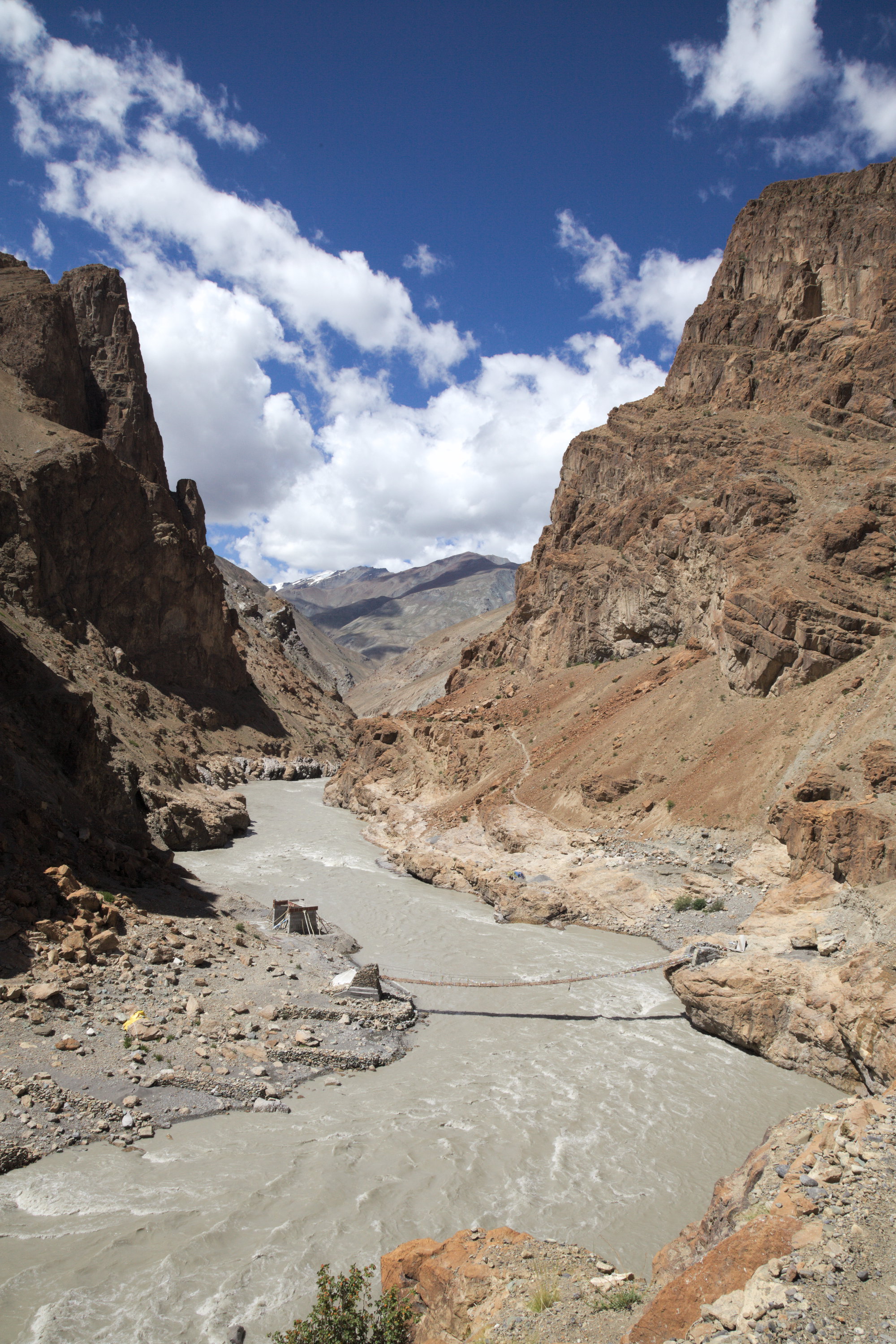
Phuktal Gorge and a Zanskari bridge

The village of Yal, between Kargyak and Phuktal