
“Are you religious sis?” asks Nazareth. We had just stopped the car for a prayer before we set off on the road. Westlife ballads are issuing from the stereo. I distractedly admit I’m not. I am busy wondering if the prayers are necessary because the roads are that bad. We are on the way to Chinland, a mountainous, inaccessible state in the west of Myanmar. One of the poorest and least developed in the country, it is home to the ethnic Chins, who are predominately Christians.
It is the middle of December, and my Facebook newsfeed is being dominated by Christmas parties back home. If I’m in Asia for Christmas, I usually prefer to be in a place that doesn’t acknowledge the day at all, as opposed to somewhere that tries to accommodate it with a sad bit of tinsel and a limited set of Christmas carols on repeat, making me feel that I’m definitely missing a much better party back home. But this year I am quietly excited to experience the celebrations in a Christian part of Myanmar.

The Falam Baptist Church
I am in a mini-van, the preferred local method of transport, to Falam, a Chin town founded by the British in 1892 and the driver, Nazareth’s home town. Although unpaved, the road has been recently widened and we weave, without incident, around the mountains into the clouds. We are passed by several motorbikes, on each two or three men carrying extremely long shot-guns. Huge swathes of hillsides, void of any sort of settlements, look to have retained their original, dense forest cover. Several areas have however, been visibly cleared for cultivation, although some are in the process of being re-subsumed by the surrounding vegetation.

The road to Falam from Kalaymyo, the nearest main town
Nazareth tells me that here most people live hand-to-mouth, surviving from hunting animals such as deer and forms of buffalo, and growing vegetables. A UN living conditions survey in 2011 reported that 70% of the Chin population lived below the poverty line, compared to a national average of 25%. Until ceasefire in 2012, the Chin hills were home to one of Myanmar’s armed insurgency groups, who claimed to be fighting for the wellbeing of their people. As I pass through tiny villages that lack even the most basic services, it is not hard to see why this would have arisen.
The Chin ethnic group, believed to be of Chinese-Tibetan descent, is actually comprised of at least 50 tribes, who speak distinct, mutually incomprehensible ‘Chin’ languages. As I find out later, often the Chin people are forced to revert to Burmese to communicate with those from other Chin tribes. Traditionally, each tribe governed themselves, through a web of local chiefdoms. The most unifying force across the different groups is their belief in Christianity. Converted by American Baptist missionaries during the late 19th and early 20th century, around 90% are Christians, and each Chin town hosts hundreds of churches.

First light on the town of Falam
My guesthouse in Falam, is a charming traditional Burmese guesthouse where one huge room has been sliced by plywood into small sleeping spaces. I am feeling pretty pleased by my largish room facing the imposing red-brick Falam Baptist Church until 5.30 the next morning when familiar Christmas carols, although in the unfamiliar Chin language, start booming from the Baptist Church’s powerful loudspeaker. A half hour prayer follows and my room choice doesn’t seem so smart now, but as I move through the guesthouse I realise nowhere is spared.

Graveyard outside Tiddim
I hope this is a special occasion as it is Sunday, although this theory is soon proven untrue. A local later tells me that last December a foreigner was staying in this guesthouse and had been so upset by these early morning services, which she says happen daily in December until Christmas, that he went directly to the church to complain. A ruckus ensued and the police had to be called.
It is the last Sunday before Christmas and Nazareth had warned me that I might struggle to find food. At around 10am all of the town’s inhabitants are in shirt and tie or colourful Burmese longyis and heels, on their way to one of the many church services, and I realise this prediction is pretty accurate. It is grey and cloudy, so I plump for Nazareth’s Unified Bible Church and experience my first Chin service.

Church elder at the Falam Baptist Church

Pastor giving sermon in Falam
People of all ages are piling in and I shyly assume a seat at the back of the church. Five pastors sit up the front, facing the congregation. During his opening welcome, one younger pastor switches easily to English, which I quickly realise is for my benefit, and smiling heads turn to inspect me. The first half of the service is exceptionally cheerful as different groups, including children, take turns at leading the Christmas carols, the words in the Chin language on a huge overhead projector. Women sway holding babies, men clap wildly, and the ministers sing solemnly with their eyes clenched shut.
The singing comes to a close after a Chin version of Amazing Grace, and the main pastor assumes his position at the pulpit. A passionate sermon follows, lasting around forty-five minutes during which old men snooze, children climb over the pews and several women chat outside. Amen. The pastor sits and wipes the sweat from his face.

House in Tiddim
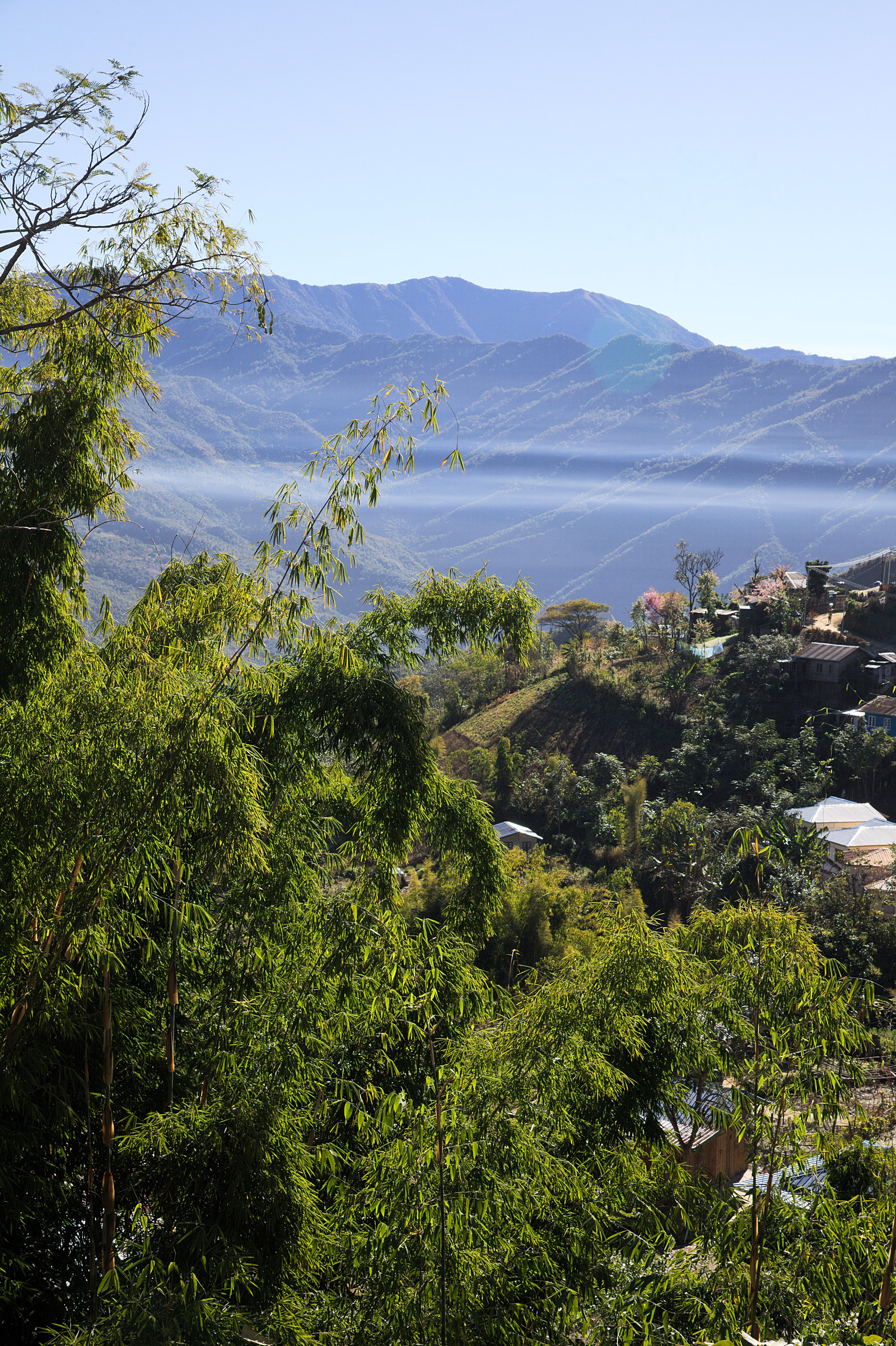
Tiddim
I return to church a few days later, this time for Christmas Day in the town of Tiddim. A few other foreigners are also in the crowd, sharing the weight of the local curiosity. “Is it like this in your country?” I get asked numerous times as I wait for the service to start. My experience in Scottish churches is distinctly limited, but I try to sound authoritative in my comparison. “We don’t sing as much,” I say, as I remember the service of dour West of Scotland Presbyterian ministers. “Yes, we are definitely not as happy. But otherwise similar.” They nod approvingly.
This service again starts with singing, which progresses quickly from cheerful Christmas carols to deafening screaming. I look around at the congregation, everyone’s eyes are closed and hands are outstretched in the air, palms facing frontwards. I see many wiping away tears. There is a further crescendo to a strange type of prayer, during which each worshipper, assuming his or her own tempo, stammers the words incredibly quickly, as if in a race to finish. Eventually, Amen. And the elderly collapse exhausted on their pews.
The pastor explains in English that the worshippers use singing to enter a meditational trance, through which they connect with God. This, he said, can be very emotional. He then launches into his sermon, later kindly translating the key points into English. “In the world, not many people know where Myanmar is on the map. And only a small proportion of those who know where Myanmar is actually know about our Chin State. Both the world and our government have forgotten about the Chin people and failed to bring development to our land. But we feel privileged, to have been gifted Jesus.”
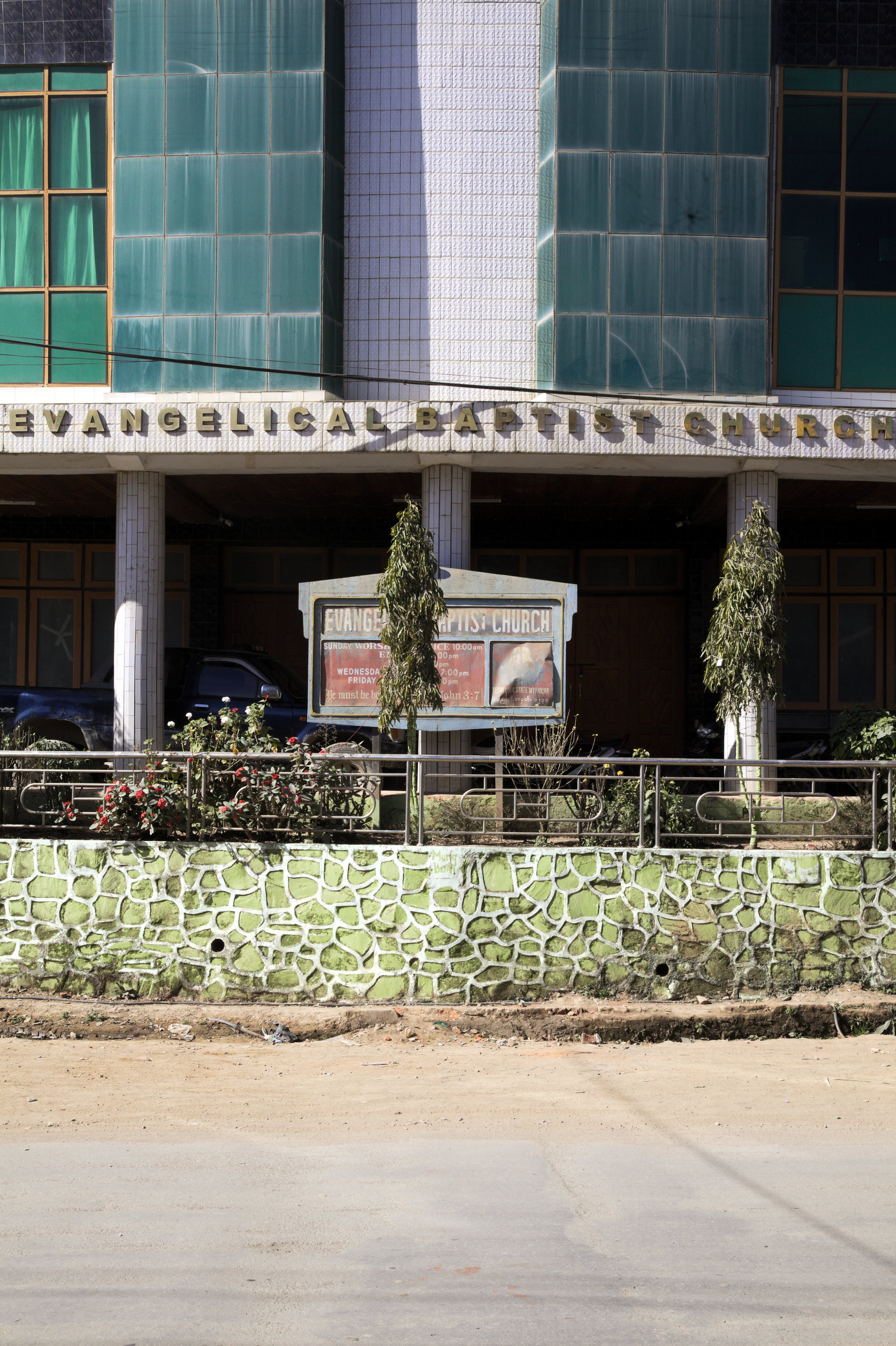
Evangelical Baptist Church (EBC) in Tiddim

A child eating at the Christmas feast at the EBC in Tiddim
I can understand why the Chins, in these remote hills, bereft of basic social services, feel forgotten. Tiddim is a mere 70 km from Kalaymyo, the nearest town with some sort of hospital, but the road journey still takes around four hours. One Burmese friend tells me that the nearest decent government hospital is actually in Yangon, a further 20 hours by bus from Kalaymyo. According to the 2011 UN report, Chin state still suffers the highest level of food poverty in the whole country, and by a large margin. For the Chins, left for decades to endure such crushing poverty, belief in a higher being appears like a reasonable choice.

Making the most of the warmth of the sun and taking a bath in Tiddim
The church has prepared a huge Christmas feast: one buffalo and six pigs have been slaughtered. Hundreds, mostly children looking slightly malnourished, dig into the meat curries and rice. Christmas in Chin, when everyone comes together to sing, pray and listen to the story of Jesus, and then share a meal with the needy in the society, is certainly aligned to the true, often forgotten, message of Christmas. That evening, after the various church feasts, trucks carrying excited children and thudding stereo systems trundle around the town, teenage boys erratically set off fire-works and run for cover, and the men drunkenly stoat home.

Tiddim style building
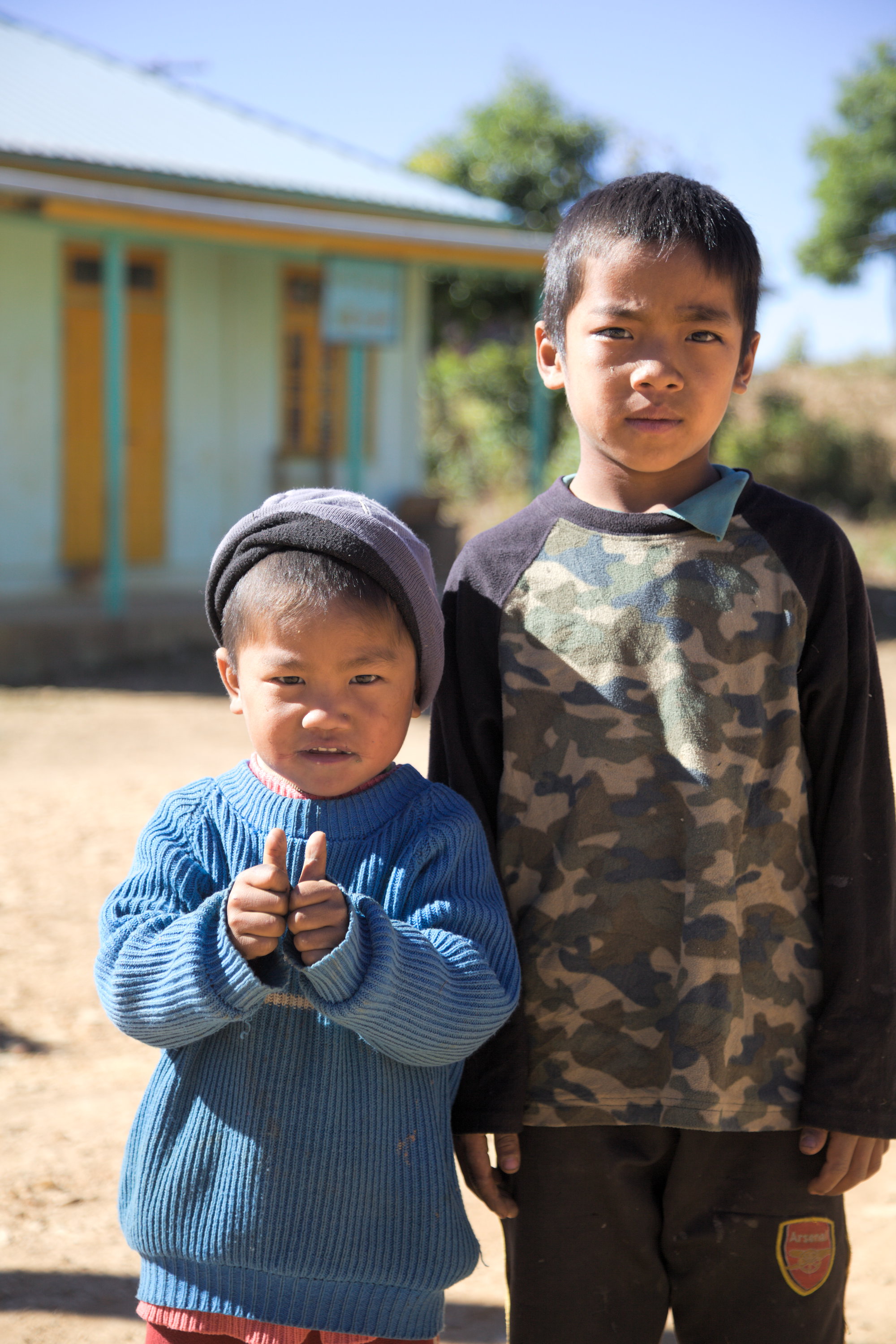
Kids in Tiddim